IMF sees UAE economy shrinking 3.9% in 2026 before 7.7% rebound in 2027
The IMF's October World Economic Outlook projects contractions across the Gulf this year, tied to its assumption that the Strait of Hormuz reopens only from March 2027.
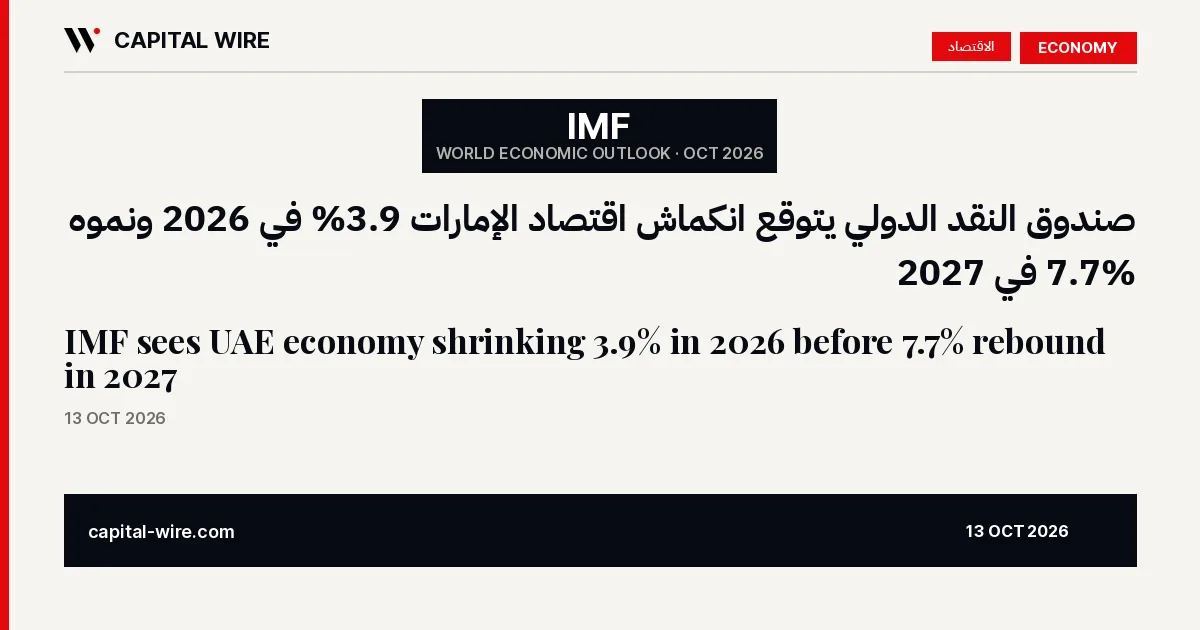
The IMF's October 2026 World Economic Outlook projects the UAE economy to contract 3.9% in 2026 and grow 7.7% in 2027, after estimated growth of 6.2% in 2025. The forecasts assume the Strait of Hormuz reopens from March 2027.
- The IMF sees Saudi Arabia's real GDP shrinking 3.3% in 2026 before growing 7.9% in 2027.
- The IMF forecasts Qatar's economy to contract 15.6% in 2026 and rebound 18.8% in 2027.
- The IMF projects the Middle East and North Africa to contract 2.0% in 2026 and grow 7.0% in 2027, with global growth at 3.1% and 3.4%.
- The IMF assumes the Strait of Hormuz reopens from March 2027, with a broad return to prewar conditions by October 2027.
The International Monetary Fund expects the UAE economy to contract 3.9% in 2026 before growing 7.7% in 2027, according to its October 2026 World Economic Outlook. The Fund estimates UAE real GDP grew 6.2% in 2025.
What happened
It sees Saudi Arabia's real GDP shrinking 3.3% in 2026 before growing 7.9% in 2027, and Qatar's contracting 15.6% before rebounding 18.8%.
For the Middle East and North Africa as a whole, the Fund forecasts a 2.0% contraction in 2026 and 7.0% growth in 2027. It projects global growth of 3.1% in 2026 and 3.4% in 2027.
Why it matters
The forecasts hinge on the IMF's assumption about the Strait of Hormuz. "The reopening of the Strait of Hormuz is assumed to resume in March 2027, with a return to prewar conditions broadly by October 2027," the IMF says in the report. The Fund adds that this implies a gradual restoration of production, shipping, insurance and payment arrangements rather than an immediate normalization of energy flows.
What to watch next
The 2027 rebounds depend on that timeline. A later reopening of the strait would push back the recovery the IMF has pencilled in for the UAE and its Gulf neighbours.
Sources
- IMF — World Economic Outlook, October 2026 (full report PDF) www.imf.org
- IMF — World Economic Outlook, October 2026 www.imf.org
- The National www.thenationalnews.com
- Aletihad en.aletihad.ae